
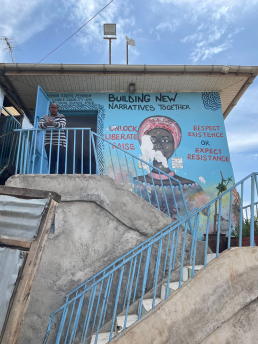
New WINGS Study Demonstrates Feasibility of Combined Intimate Partner Violence and Mental Health Intervention for Women in Nairobi Informal Settlements
New WINGS Study Demonstrates Feasibility of Combined Intimate Partner Violence and Mental Health Intervention for Women in Nairobi Informal Settlements
Pilot randomized controlled trial shows significant reductions in IPV and improvements in mental health across both intervention arms over six months
Researchers at Columbia University, in partnership with the Africa Institute of Mental and Brain Health in Nairobi and Boston University, have published findings from a pilot randomized controlled trial testing a combined intimate partner violence (IPV) and mental health intervention for women living in informal settlements in Kenya. The study, published in Social Science & Medicine, demonstrates that the combined intervention — WINGS+PM+ — is feasible, safe, and acceptable in resource-limited settings, with promising improvements in both IPV and mental health outcomes.
Background and Need
Intimate partner violence affects an estimated 30% of women globally, with rates in Kenya approaching 39% — and as high as 85% lifetime prevalence in Nairobi’s informal settlements. IPV is closely linked to common mental health disorders including depression, anxiety, and post-traumatic stress disorder (PTSD), yet access to both IPV-specific and mental health services in these communities is severely limited.
Over one billion people worldwide live in informal settlements, a population that is growing. In Nairobi, more than half the city’s population resides in informal settlements, where essential public health infrastructure remains scarce and dedicated IPV programs are largely absent.
About the Study
The research team recruited 260 women from two public health clinics in Nairobi’s Mathare and Kibera settlements between May and August 2024. Eligible participants were 18 or older, had experienced IPV in the prior three months, and felt safe to participate. Participants were randomly assigned to one of two arms:
- WINGS+PM+ (treatment): Seven 90-minute weekly sessions integrating Problem Management Plus (PM+), a WHO-developed psychological intervention, with WINGS — a screening, brief intervention, and referral to treatment (SBIRT) model addressing IPV specifically.
- PM+ only (control): Five 90-minute weekly sessions focused on stress management, problem-solving, building social support, and positive activity engagement.
All sessions were delivered by trained community health promoters — community members already embedded in local health systems — making the intervention scalable and low-cost.
Key Findings
Feasibility and Acceptability
- 93.5% of participants completed the six-month follow-up assessment.
- Approximately 96% of participants across both arms completed all assigned sessions.
- Roughly 99% of participants reported satisfaction with the intervention.
- No adverse events occurred as a result of study participation.
IPV and Mental Health Outcomes
- Both arms showed significant reductions in all forms of IPV — psychological, physical, and sexual — at six months compared to baseline.
- Both arms showed significant improvements in depression, anxiety, PTSD, disability/functioning, and personalized problems at six months.
- Participants in the WINGS+PM+ arm showed significantly lower PTSD scores compared to PM+ alone at three months, suggesting IPV-specific content may provide short-term trauma benefits.
- Self-efficacy scores and IPV service utilization increased significantly over time.
Significance and Next Steps
This is the first randomized controlled trial to evaluate a combined IPV screening, brief intervention, and referral to treatment intervention alongside a psychological distress reduction program among women living in extreme poverty. The authors note that the strong performance of PM+ alone may have limited the ability to detect additional benefits from WINGS components in this feasibility study, and recommend a fully powered efficacy trial — potentially with a three-arm design — to better isolate the effects of each intervention component.
The authors also highlight the importance of addressing the noted disparities between clinic sites, and the need for longer-term follow-up assessments in future studies.
About the Organizations
Columbia University (New York, NY): Lead institution for the study, home to the research team that conceptualized and led the trial.
Africa Institute of Mental and Brain Health (Nairobi, Kenya): Kenyan partner institution responsible for in-country implementation, community engagement, and supervision.
Boston University (Boston, MA): Contributing partner providing biostatistical expertise and analytical support.
Funding
This study was funded by the Fogarty International Center at the National Institutes of Health (K01TW011775). The funder had no role in study design or analysis.
Citation
Winter, S.C., Obara, L.M., Ndetei, D., Mutiso, V., Gilbert, L., Bellamy, S.L., Shin, G.U., Shrestha, A., & Witte, S.S. (2026). Feasibility and preliminary effectiveness of a combined intimate partner violence (IPV) and mental health intervention (WINGS+PM+) for women in informal settlements in Kenya. Social Science & Medicine, 395, 119095. https://doi.org/10.1016/j.socscimed.2026.119095
Contact
Samantha C. Winter, PhD
Columbia University, School of Social Work
1255 Amsterdam Ave, Room 711, New York, NY
Email: scw2154@columbia.edu

WINGS Mobile Health Intervention Significantly Reduces Intimate Partner Violence Among Marginalized Women in Kazakhstan, New Study Finds
WINGS Mobile Health Intervention Significantly Reduces Intimate Partner Violence Among Marginalized Women in Kazakhstan, New Study Finds
UMAI-WINGS trial demonstrates up to 29% reduction in physical, sexual, and psychological violence using a community-driven digital approach
A groundbreaking community-based trial has found that a self-paced mobile health (mHealth) intervention called UMAI-WINGS significantly reduced all forms of intimate partner violence (IPV) among some of Kazakhstan’s most vulnerable women, including women who use drugs, engage in sex work, live with HIV, and identify as transgender. The findings, published today in the journal Behavioral Sciences, represent the largest community-based trial of an IPV screening, brief intervention, and referral to treatment (SBIRT) model with key affected populations to date.
Key Findings
The study enrolled 508 women across two sites in Kazakhstan—Almaty City (intervention) and Almaty Oblast (waitlist control)—and assessed outcomes at baseline and six months post-intervention. After adjusting for demographic and behavioral factors, women who received the UMAI-WINGS intervention were:
- 23% less likely to report psychological IPV
- 27% less likely to report sexual IPV
- 29% less likely to report physical IPV
compared to women in the control group. Crucially, the intervention was effective across all subgroups of key affected populations, with no significant differences in outcomes among women who use drugs, women engaged in sex work, or women living with HIV.
The intervention also demonstrated high acceptability, with 81% of participants reporting satisfaction and 94% saying they would recommend it to other women. No adverse safety events were reported throughout the study.
A Crisis Demanding Action
The study underscores the scale of violence facing marginalized women in Kazakhstan. At baseline, approximately two-thirds of participants reported experiencing psychological and sexual IPV in the prior six months, and over half reported physical violence—rates dramatically higher than the national average of 27%. Many participants also faced severe socioeconomic hardship: over 40% had experienced homelessness in the past year and more than half reported food insecurity.
How UMAI-WINGS Works
UMAI-WINGS is adapted from the evidence-based WINGS (Women Initiating New Goals of Safety) model, which has been successfully implemented in the United States, Kyrgyzstan, India, and Ukraine. The mobile health tool guides women through seven core components: raising awareness about IPV, personalized risk screening, motivational interviewing, safety planning, enhancing social support, goal setting, and linkage to local services.
The intervention was culturally adapted through an iterative process involving Community Action and Accountability Boards (CAABs)—multisectoral groups comprising IPV service providers, law enforcement, NGOs serving key populations, and women with lived experience of violence. CAABs played a central role in tailoring content, building cross-sector service networks, reducing barriers to care, and ensuring sustainability.
“The community-coordinated approach was essential to this intervention’s success,” said **Dr. Louisa Gilbert**, co-investigator and Professor at the Columbia University School of Social Work. “By engaging local stakeholders at every stage—from adaptation to implementation—we built trust, expanded access to services, and created an ecosystem of support that extends far beyond the app itself. “These findings reveal both the depth of this crisis and the promise of community-driven, digital solutions.”
A Scalable Model for Global Impact
The digital, self-administered design of UMAI-WINGS makes it uniquely scalable. Women can engage with IPV education, safety planning tools, and service referrals privately from a mobile device—eliminating many logistical and safety barriers associated with traditional face-to-face programs. A built-in “safe exit” feature allows users to quickly close the tool if interrupted, and participants can choose how to receive their personalized safety plans.
“This model demonstrates that effective, evidence-based IPV prevention can be delivered at scale through mobile technology, even in low-resource, high-stigma settings,” said Dr. Sholpan Primbetova, co-Principal Investigator and researcher at the Global Health Research Center of Central Asia and Al-Farabi Kazakh National University. “It offers a blueprint for reaching women who have historically been invisible in both research and policy.”
Policy Implications
The researchers call for several policy actions based on their findings:
- Integration of routine IPV screeninginto primary health care settings, particularly for marginalized populations
- Expansion of inclusive IPV services, including shelters and legal aid, that do not discriminate against women based on HIV status, drug use history, sex work involvement, or gender identity
- Investment in community-based, multisectoral coordination modelsto bridge gaps between mainstream services and organizations serving key populations
- Increased surveillance and data collectionon IPV among key affected populations, who are routinely excluded from national surveys
About the Study
The UMAI-WINGS trial was conducted from April 2022 to December 2024 by an international research team from the Global Health Research Center of Central Asia, the Center of Scientific and Practical Initiatives (Almaty), Columbia University School of Social Work, Columbia University Mailman School of Public Health, the University of Washington School of Public Health, Al-Farabi Kazakh National University, and community partner organizations including the Crisis Center Union and Public Foundation “Revansh.” The study was funded by the Sexual Violence Research Initiative (SVRI), with additional support from the National Institutes of Health.
Citation
Terlikbayeva, A., Primbetova, S., Gatanaga, O. S., Chang, M., Rozental, Y., Nurkatova, M., Baisakova, Z., Bilokon, Y., Karan, S. E., Dasgupta, A., & Gilbert, L. (2025). UMAI-WINGS: Evaluating the Effectiveness of Implementing mHealth Intimate Partner Violence Prevention Intervention in Reducing Intimate Partner Violence Among Women from Key Affected Populations in Kazakhstan Using a Community-Based Approach. Behavioral Sciences, 15(5), 641.
Contacts
Dr. Sholpan Primbetova (corresponding author)
Global Health Research Center of Central Asia / Al-Farabi Kazakh National University
Email: sholpan.primbetova@ghrcca.org
Dr. Assel Terlikbayeva
Center of Scientific and Practical Initiatives / Global Health Research Center of Central Asia
Email: assel.terlikbayeva@ghrcca.org
Dr. Louisa Gilbert
School of Social Work, Columbia University
Email: lg123@columbia.edu
From Two NGOs to a National Network: A Ten-Year Case Study of the WINGS Gender-Based Violence Intervention in Kyrgyzstan
From Two NGOs to a National Network: A Ten-Year Case Study of the WINGS Gender-Based Violence Intervention in Kyrgyzstan
New book chapter documents how a community-led, evidence-based intervention grew from a two-NGO pilot to 14 agencies serving over 1,000 women across Kyrgyzstan — and is now active in six countries
A newly published book chapter by researchers and practitioners at the GLORI Foundation and Columbia University documents ten years of implementing the Women Initiating New Goals of Safety (WINGS) intervention in Kyrgyzstan, offering a detailed case study of how a community-driven, evidence-based gender-based violence (GBV) prevention model can be sustained, scaled, and adapted in a resource-limited setting.
The Problem: GBV Among Kyrgyzstan’s Most Marginalised Women
Gender-based violence remains a serious public health crisis in Kyrgyzstan. Women who use drugs and women engaged in sex work face especially elevated rates of IPV, with research showing that nearly 80% of women who use drugs experienced violence from intimate partners in a single year, and 68% of sex workers reported experiencing violence from law enforcement. Fear of discrimination and criminalisation often prevents these women from seeking help, creating a cycle in which violence and substance use reinforce one another.
When WINGS was first piloted in Kyrgyzstan in 2013, no sustainable, evidence-based mechanisms existed for changing behavioural norms around violence among government agencies, local communities, or survivors’ social networks.
About the WINGS Intervention
WINGS is a screening, brief intervention, and referral to treatment (SBIRT) model delivered in one to two individual sessions by trained non-specialist facilitators. Its core components include psychoeducation on the types and dynamics of GBV and IPV, structured screening to identify violence, motivational support and safety planning, goal setting, and linkage to relevant health and social services. In Kyrgyzstan, the model was further adapted to include optional overdose prevention training — reflecting the documented link between GBV exposure and drug overdose risk among women who use drugs.
WINGS was originally developed by Dr Louisa Gilbert and colleagues at the Columbia University Social Intervention Group in the United States, and adapted for the Kyrgyz context through extensive community engagement and collaboration between the GLORI Foundation and local NGO partners.
Key Milestones: 2013 to Present
WINGS of Hope (2013–2016)
The GLORI Foundation, with NGO partners Asteria and Podruga and support from Open Society Foundations and Soros Foundation Kyrgyzstan, launched the first WINGS pilot with women who use drugs in Bishkek and Osh. Between 2013 and 2016, 213 women received services. Participating women demonstrated significant reductions in all types of GBV and IPV, reductions in substance use, improved safety planning skills, and increased use of GBV-related referral services.
WINGS SUNFLOWER (2019)
In partnership with UNDP and six non-government crisis centers, GLORI integrated the WINGS model with South Korea’s Sunflower Center one-stop service framework, expanding multi-disciplinary GBV services to a single-location model. In the first year alone, more than 100 women received services. The project strengthened collaboration between NGOs and the Ministries of Internal Affairs and Labour and Social Development.
Rural WINGS (2023)
Supported by a grant from the BEARR Trust, the Chance Crisis Center and GLORI Foundation brought the WINGS methodology to the rural Moskovsky district of Chu Region — a community of more than 100,000 people with no crisis centers and limited access to trained psychologists. Municipal social protection agency staff were trained as facilitators, demonstrating the model’s adaptability to government infrastructure in underserved rural areas.
A Growing National Network
The number of agencies trained in the WINGS methodology grew from 2 in 2013 to 14 by 2022. Today, 14 WINGS Resource Centers (WRCs) operate across Kyrgyzstan — seven in Bishkek and Chu region, four in Osh, two in Karakol, and one in Naryn. Of these, four are advocacy and policy-making bodies and ten are frontline service providers. Three manage shelters. More than 1,000 women have received WINGS-specific services through this network.
A central feature of the network is the No Violence Coalition (NOVIC), a 35-member community advisory working group uniting NGO leadership, government ministry representatives, journalists, academics, and international donors. NOVIC members collaboratively pursue grant funding and advocacy campaigns to sustain and scale the WINGS model.
International Reach and Future Directions
Building on the Kyrgyz experience, WINGS has been adapted and implemented in the United States, India, Georgia, Ukraine, Uzbekistan, Kenya, Indonesia, Georgia and Kazakhstan. In Kazakhstan, a fully computerised version of the intervention allows women to independently navigate all stages via smartphone or computer with interactive avatar guidance. The WINGS methodology is available in eight languages through an online resource center operated by the GLORI Foundation.
The authors identify several priority areas for future expansion: reaching border regions with high concentrations of labour migrants (currently underserved by any GBV-specific intervention), adapting the model for young people using novel psychoactive substances, and continuing efforts to integrate WINGS services into routine government-delivered care.
About the Organizations
GLORI Foundation (Global Research Institute, Bishkek, Kyrgyzstan): The lead implementing and research organisation for WINGS in Kyrgyzstan and the Central Asia region.
Columbia University Social Intervention Group (New York, NY, USA): The original developers of the WINGS model, providing ongoing scientific, technical, and capacity-building support for international adaptation and implementation.
Funding
WINGS in Kyrgyzstan has been funded at various stages by the International Harm Reduction Development Program at Open Society Foundations, Soros Foundation Kyrgyzstan, UNDP in the Kyrgyz Republic, the Alliance for Public Health, and the BEARR Trust.
Citation
Nikitin, D., Bessonova, A., Gilbert, L., Jiwatram-Negron, T., & Terlikbayeva, A. (2024). WINGS in Kyrgyzstan: An Intervention for Gender-Based Violence Prevention. In Shadymanova (Ed.), NGO Involvement in Drug Treatment and Infectious Disease Prevention in Central Asia and China. Nomos.
Contact
Danil Nikitin
GLORI Foundation (Global Research Institute)
Bishkek, Kyrgyz Republic